
01
Consolidated view
Clients, sites, assets, systems, applications, incidents, requests, dependencies and commitments are put back into context.
TECKINFO standalone product
The operational control center that connects your clients, contracts, sites, systems, applications, incidents, service commitments, teams and interventions into a governed and actionable view.
SEE. UNDERSTAND. AUTHORIZE. ACT. PROVE. GCC does not replace the business engine of your applications: it gives them the operational context, intervention limits, governance and traceability required for control.
GCC logo. This page does not use fake product screens: the interfaces shown below come from the real SECUR-AID Admin operational foundation and are clearly identified as such.
What you actually buy
A decision-maker does not buy a collection of screens. They buy certainty about what is under control, what is not, who is responsible, who is allowed to act and how to prove it.
Clients, sites, assets, systems, applications, incidents, requests, dependencies and commitments are put back into context.
Rights are not a simple button. They depend on role, client, scope, asset, action type and required validations.
Action queues, alerts, incidents, procedures, schedules and support become readable for operations as well as management.
A sensitive action must be tied to an identity, a reason, an authorization, a timestamp, a result and an audit trail.
Client transformation
Contract-to-Action
GCC’s central differentiator is linking the right to intervene to the real context. The principle is simple: no valid contractual commitment or authorization = no TECKINFO intervention.
The GCC control model must be able to follow this chain without reducing it to a simple interface filter.
Roles and separation of responsibilities
The SECUR-AID Admin foundation already works today with three distinct operational roles. GCC generalizes this logic: each client may define roles, scopes, validations and rights suited to its organization.
Review, prepare and execute permitted operations without automatically gaining higher privileges.
Monitor priorities, queues, delays, situations to qualify and validations that belong to this level.
Carry the binding arbitrations and validations defined by the client organization and governance.
Your GCC, not an imposed template
Each deployment may present different modules, menus, roles, workflows, validations, dashboards, KPIs, SLA/SLC rules and connectors depending on the contract and the real need.
TECKINFO operates GCC for the scope that is actually entrusted to it: systems, applications, support, incidents, procedures, governance and reporting according to the contract.
Another client may activate only a few scopes: for example two applications, the associated support and service indicators. GCC does not derive its value from unnecessary complexity.
Start with a useful scope, obtain value quickly, then extend coverage when the organization and contract justify it.
The client may acquire GCC and have it configured according to companies, sites, teams, roles, assets, workflows, applications, KPIs, SLA/SLC and integrations.
Installation, configuration, support, maintenance or operations are provided only within the contractual scope agreed with the client.
Two delivery models
For organizations that want to delegate all or part of operational steering. GCC is configured according to real commitments, and TECKINFO intervenes only within the authorized scope.
For organizations that want to run their own control center. GCC is configured around their organization and processes, with TECKINFO support according to the contract.
Evidence from the existing operational foundation
These screenshots are shown as evidence of TECKINFO’s operational experience in supervision, action queues and traceability. They are not artificially relabeled as “GCC screens”.
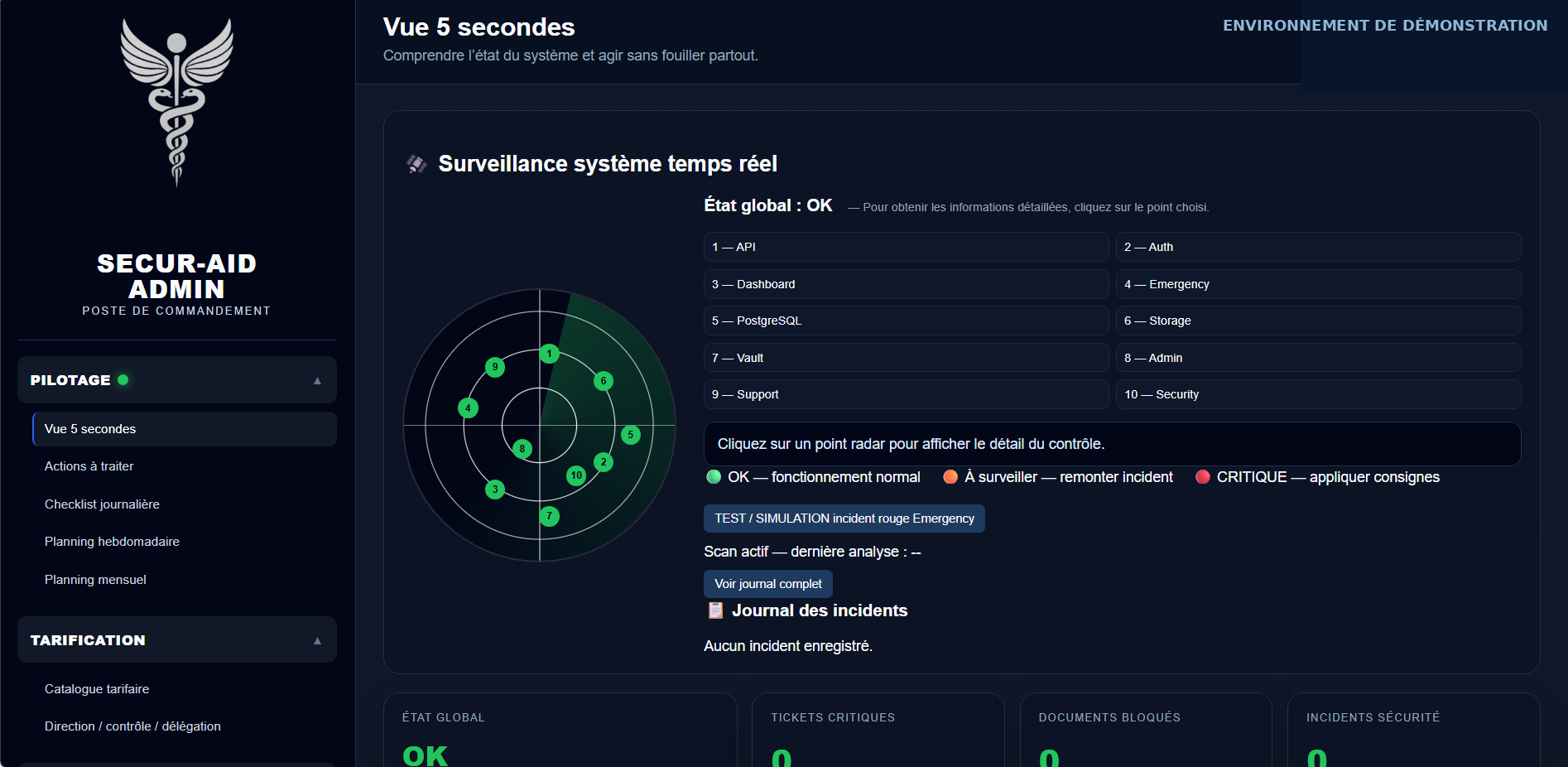
Global status, real-time supervision, control points and indicators: the principle is to understand before browsing menus.
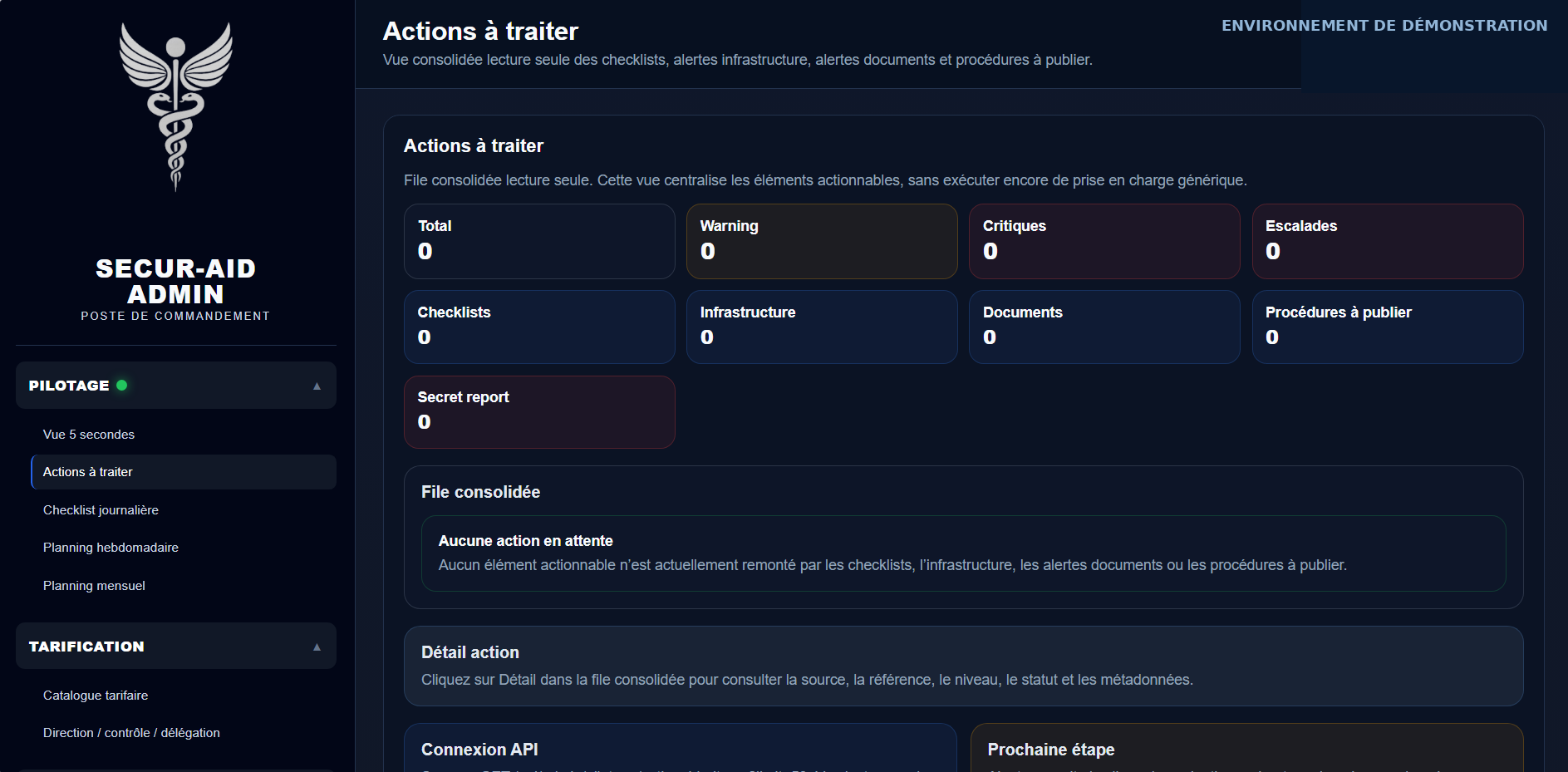
A consolidated queue groups actionable items without automatically turning supervision into unauthorized action.
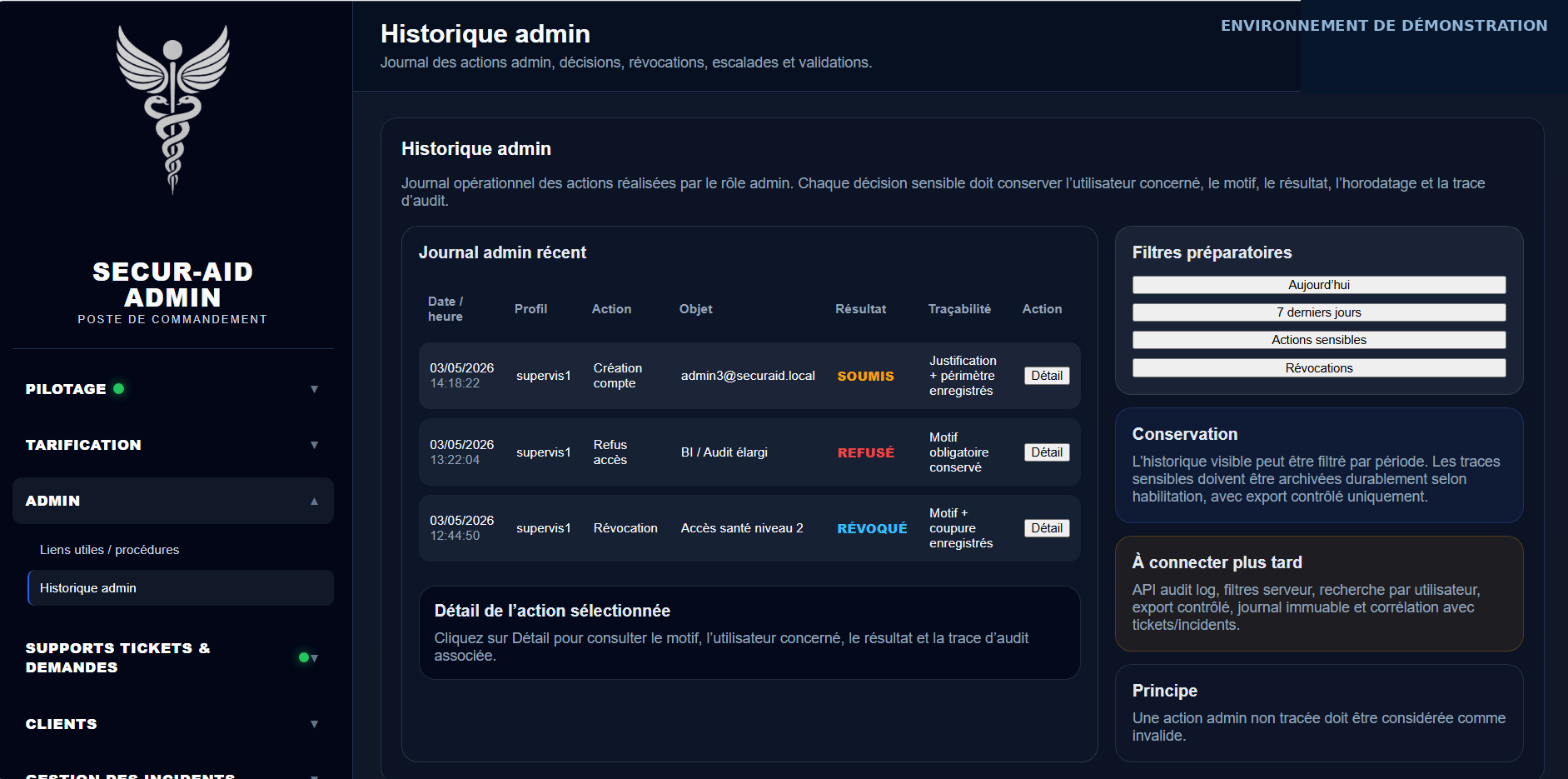
Sensitive decisions, validations, revocations and actions must preserve reason, context, result and traceability.
Some visible areas in the foundation explicitly carry demonstration, read-only or “to be connected later” mentions. They are therefore not presented here as already finalized production capabilities inside GCC.
Included from day one
Initial framing is part of the GCC experience to be calibrated in the offer and contract. The goal is to reduce the time between purchase and a genuinely useful cockpit.
Understand companies, sites, teams, responsibilities, systems, applications, constraints and priorities.
Link commitments to the services, assets and intervention types that are actually concerned.
Structure the elements GCC must supervise or contextualize without unnecessarily recreating what already exists.
Select the indicators that are useful for operations and management instead of multiplying metrics with no decision attached.
Define who sees, who prepares, who validates, who acts and within which limits.
Put a first useful and understandable view into service before extending the scope.
Give teams control over the configuration and operation that matches their responsibility.
Revisit views, rules, alerts and processes after start-up to simplify what should be simplified.
Why a buyer should not walk away from GCC
Menus, modules, roles and dashboards are activated according to the client’s real need.
GCC is designed to complement the existing environment through integrations and phased adoption instead of provoking a big bang.
Least privilege, contract, scope and authorizations must determine what is accessible and actionable.
The page distinguishes real evidence, the GCC target and future integrations. No capability is invented just to impress.
The commercial design must cover ownership, access, retention, export and reversibility in understandable terms.
Start with a useful scope, prove the value, then expand: complexity must never be a prerequisite for adoption.
TECKINFO ecosystem
Handles requests, tickets, processing, SLA and escalations. GCC brings context, scope and governance to the intervention.
Remains an autonomous business product with its own administration. GCC may consolidate its status without becoming a universal gateway to sensitive data.
Every new site, application, provider, contract, SLA or incident increases the cost of not knowing exactly what is under responsibility, what requires action and who is authorized to act. GCC lets you start with a clear perimeter and then extend it without losing control.